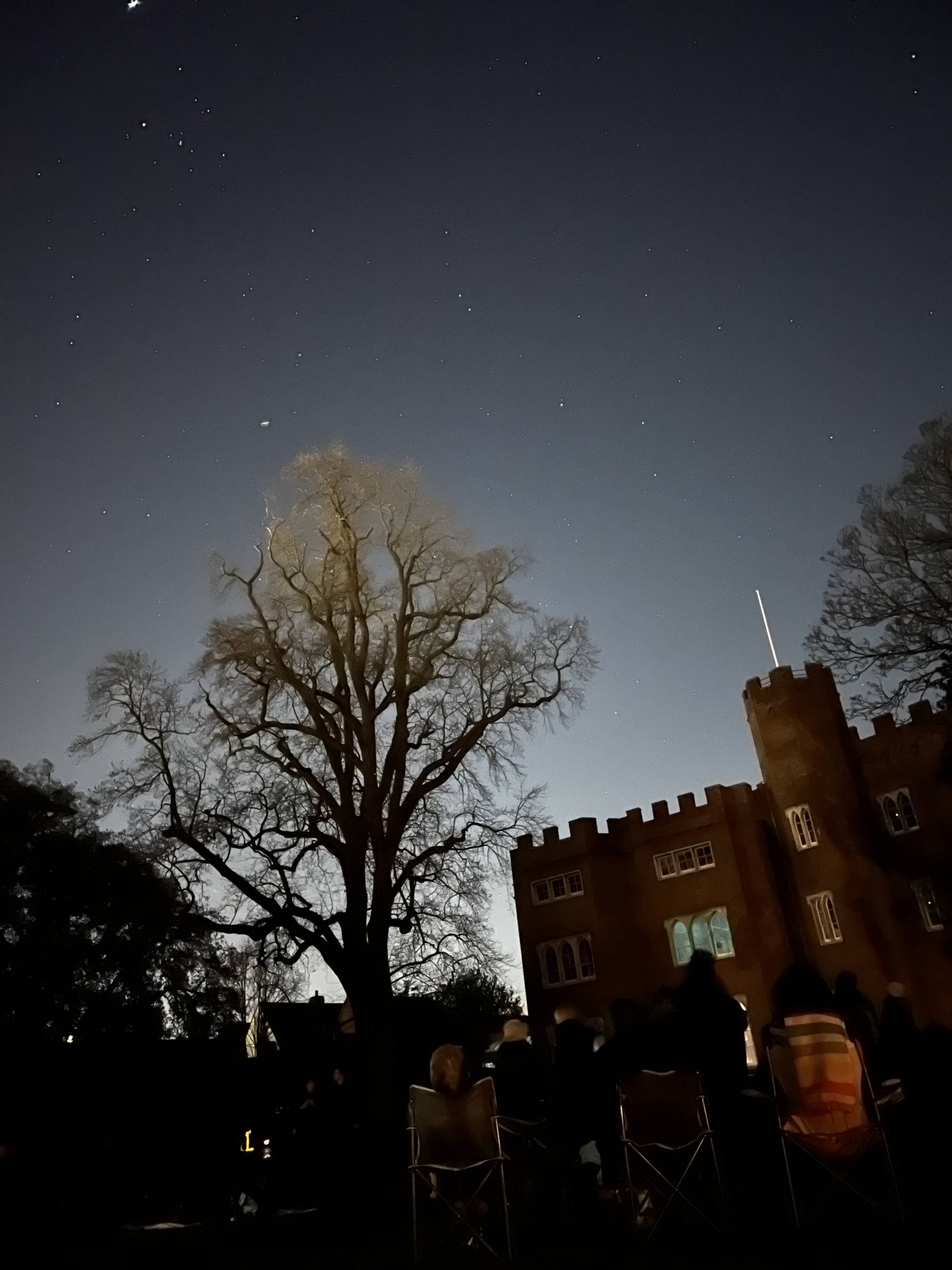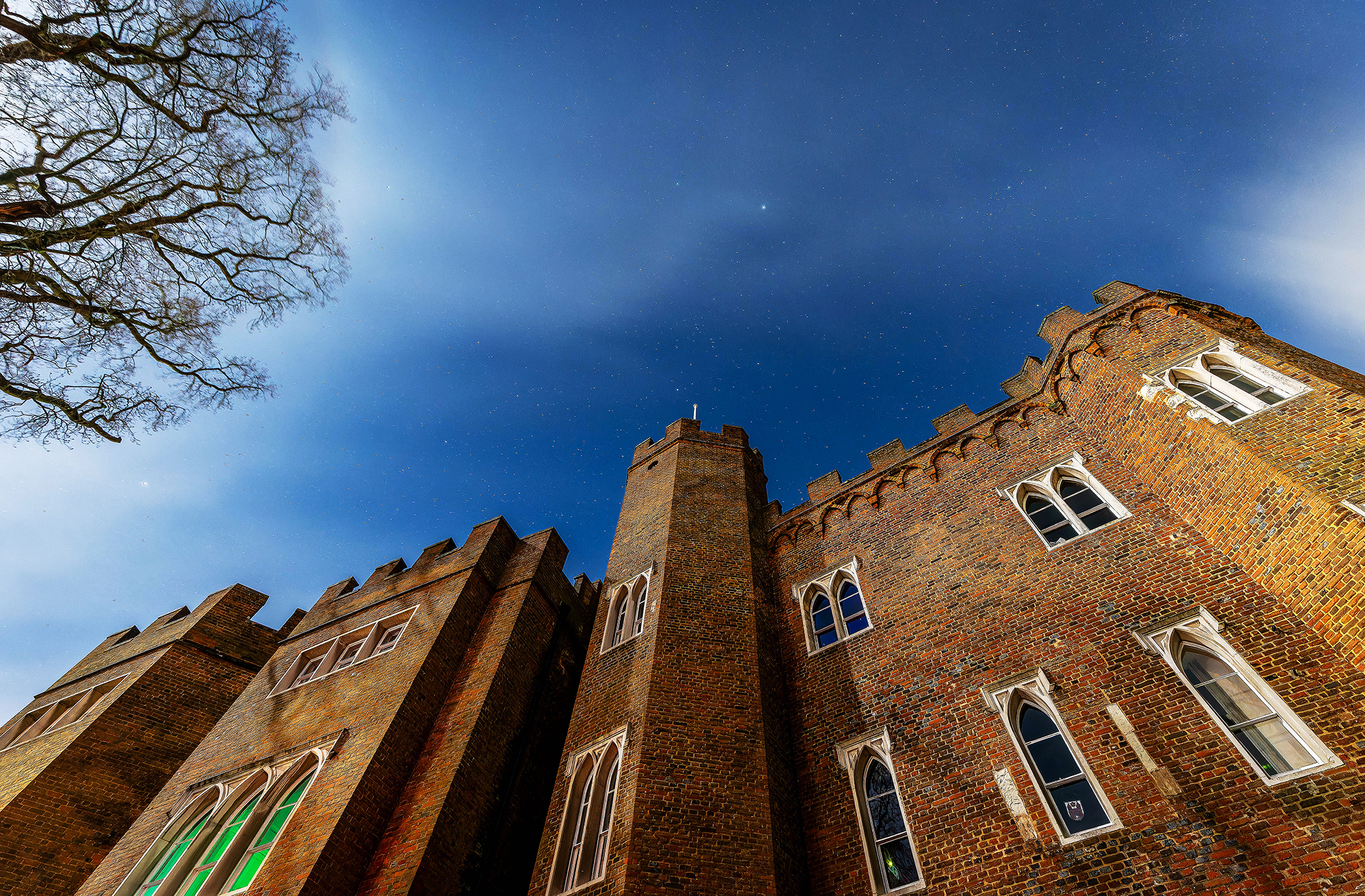
The second Hertford Dark Skies event went ahead with clear skies on the 1st February 2025.
This annual event was conceived back in 2022 with the intention to sow seeds among individuals, businesses and the community to make steps towards darker skies and better quality lighting in the county town of Hertford. I initially suggested the idea in January 2023 to Hertford Town Council who were extremely receptive to it. Later that year I spoke to the new Town Mayor who fully embraced the idea and I worked with Hertford Town Council to make it happen. The first event took place in February 2024.
Hertford is 25 miles north of London with a population of 30,000 and is surrounded by rural areas. It feels like a manageable entity to one day become a considerately lit town for both its residents and the surrounding ecology.
Creating a dark sky event is a fantastic way of making a start on that journey and raising awareness about light pollution. It also provides an opportunity for the community to come together and celebrate the night sky. Switching off lights ensures that people do not experience unwanted glare causing contrast and adaptation issues that inhibit their ability to see the night sky clearly. Such an event also provides the opportunity to bring in local experts and enthusiasts to share knowledge and inspire others.
This year, Bayfordbury Observatory: University of Hertfordshire, Hertford Astronomy Group, Herts Amphibian and Reptile Group and Herts & Middlesex Wildlife Trust returned from last year’s successful event to participate again. In addition, BEAM Hertford, the local theatre and cinema, and CPRE Hertfordshire joined the event to increase the offering to the 350 allocated attendees.
The Cinema Screening
The prospect of adding a cinema screening was very exciting. The event began at 3pm at Beam Hertford where ‘The City Dark’ film by Ian Cheney was shown to a sold out audience in Screen 1. During the selection process numerous films were reviewed relating to the impacts and effects of artificial lighting at night. The intention was to find something that could be enjoyed on the big screen by members of the public outside of the lighting industry, but still get the important messages across. The City Dark is a feature documentary about light pollution, exploring the experiences of filmmaker Ian Cheney after moving from rural Maine to New York City. It questions our need to be able to see the night sky and postulates that having a relationship with the stars is a basic requirement of what it is to be human. It was a perfect fit.
I did a talk following the film that expanded upon some elements that were missing. The City Dark was released in 2011 and, as it was being made, the lighting industry was undergoing the LED revolution; meaning all other light sources for new street and urban lighting were to be quickly superseded. The impacts of the vastly different spectral distributions of LED light sources in comparison to high and low pressure sodium needed to be highlighted. In particular, the increased disruption caused by the blue portion of the spectrum on human health and our natural world. I also explained what measures can be taken, as individuals, businesses or as a community, to reduce light pollution and the impact of artificial light on nature.
The film and talk were very well received with an abundance of questions from the audience afterwards. Everyone then had the opportunity to make their way to the outdoor event at the castle next door, where the event was getting underway. ossible.
The Castle Event
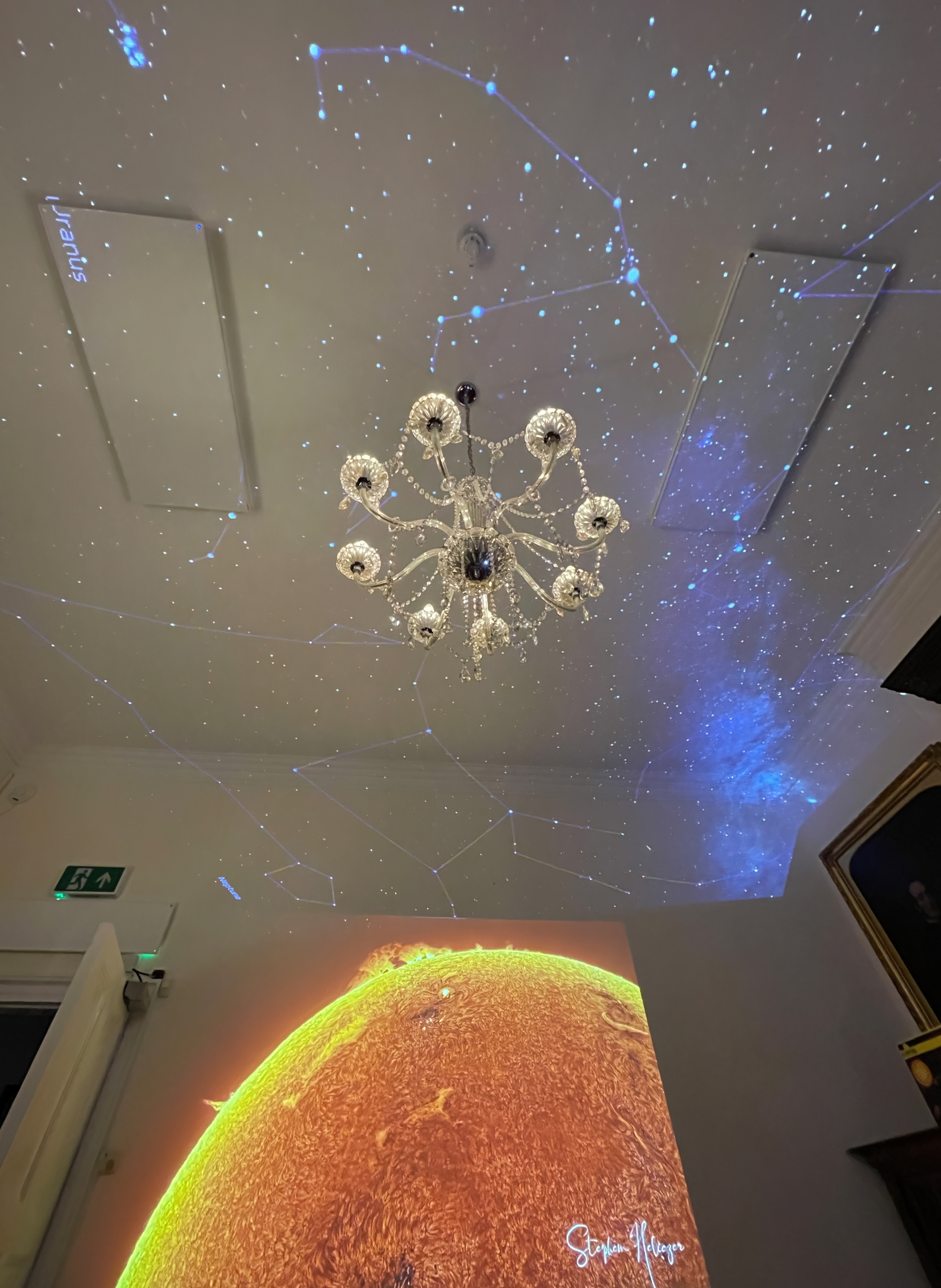
The event had always planned for the possibility of clouds by including indoor talks and activities, along with a mobile planetarium from Bayfordbury Observatory. The planetarium allowed 30 people to attend every 30 minutes with tickets booked and purchased in advance. Images of the solar system were projected onto its domed ceiling providing immersive experiences regardless of the weather.
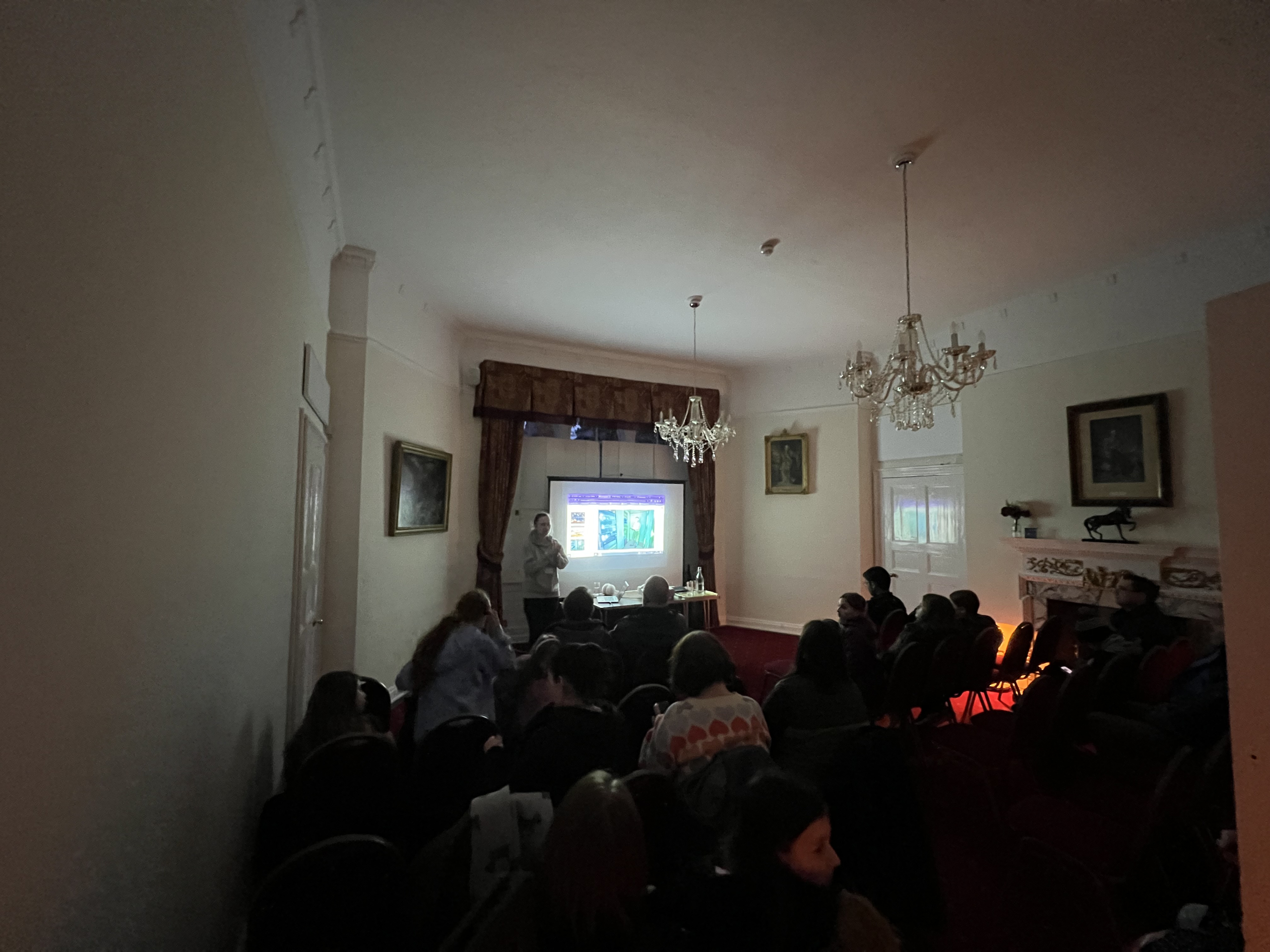
The indoor talks were all well attended and could have taken place with or without clear skies. Bayfordbury Observatory presented ‘An Introduction to Astronomy’, Herts Amphibian and Reptile Group spoke about amphibians and their nocturnal behaviour and I spoke about how artificial lighting at night affects people and the planet.
Hertford Astronomy Group had a dedicated room within the castle to be able to project onto the ceiling, produce slide shows on the wall, demonstrate equipment and display some amazing astrophotography.
Children had the option of indoor entertainment too. Local author Alice Hemming used a shadow puppet theatre to re-tell some of her stories and allow children to create their own shadow puppets too.
The grounds to the castle were open from 5pm. As dusk descended, an overcast sky quickly became a clear, starry one.
Hertford Astronomy group had various telescopes available for people to look at different stars and constellations, including the clearly visible moons of Jupiter.
Herts and Middlesex Wildlife Trust were present to talk to people about the effects of artificial lighting on wildlife. They also conducted nocturnal nature walks throughout the event for children and adults to observe nature in the darkness.
CPRE Hertfordshire, the countryside charity, gave people the opportunity to spot star constellations and measure the clarity of the night sky through the use of limiting magnitude sky charts, part of the ongoing citizen science project: Globe at Night.
LAPD Lighting were conducting some visual experiments to lots of interested participants that demonstrated the human perception of colour after dark.
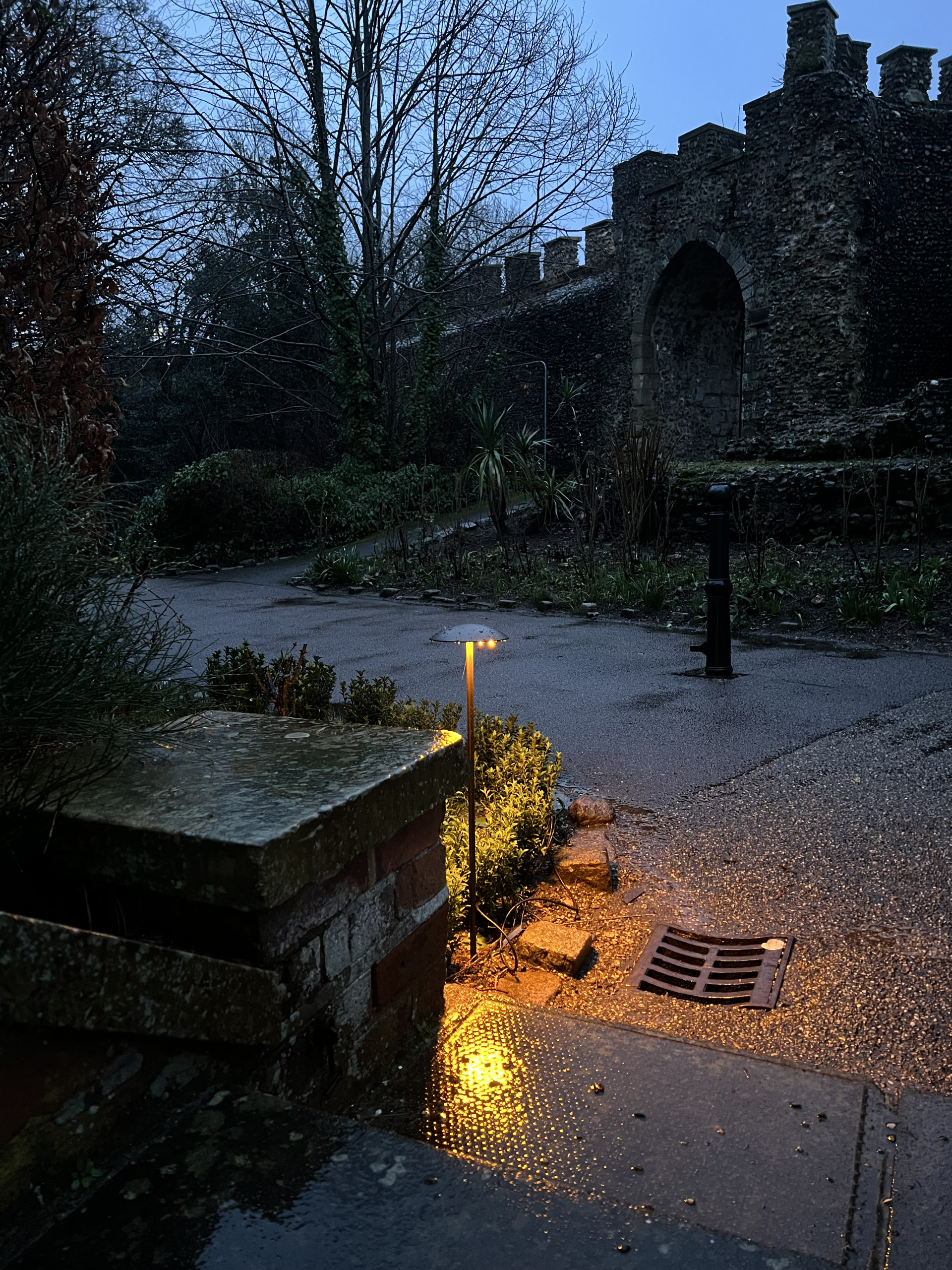
Lighting for all of the gazebos housing the participants was discreetly provided by a combination of red filters over some lights and Stoane Lighting’s Tadpole luminaires. The Tadpoles were provided with a resistor and remote battery packs requiring three AA batteries to be able to run a PC Amber LED source just below 2 watts. The Tadpoles are extremely small and can be hidden, suspended or tied to surfaces to emit amber light with a spectral distribution that has minimal impact on the surrounding ecology. They also came with chamfered glare snoots to reduce glare to a minimum. Red filters were also used for the catering area and St John’s Ambulance station who had brought their own higher output lights.
Last year’s event occurred under an almost full moon, providing plenty of light throughout the outdoor areas. This year the moon was a waxing crescent which was 13% illuminated and, after all of the park lighting was switched off at 18:45pm, the darkness was noticeable. Adaptation time was important particularly as it was not possible to turn off all lighting across the horizon, including the high mast lighting on the A414. These, and other lights further afield, had an effect on the adaption of the eye and Tadpole luminaires were hidden in a small number of locations to illuminate uneven ground. The battery packs for these lights were concealed within dry bags in the event of rain. As the event grows each year there will be an opportunity to increase the footprint of lighting switch off or improvement to improve the lit effect further, and to increase the activities provided by participants and partners.
At 7pm, fifteen minutes after the switch off occurred, Bayfordbury Obervatory began a talk through the night sky. It was pleasing to have a starry sky for all to see. People stood, sat on camping chairs, or lay on picnic blankets looking up at the stars while Sam Rolfe, from the observatory, showed them the clearly visible planets of Venus and Mars and directed everyone to different constellations. The talk, originally planned for 30 minutes, filled the hour until the event closed at 8pm. While this was happening people still had the opportunity to look through telescopes or conduct their own star count.
The feedback from the event was very positive. It inevitably makes an event like this special when the sky is clear, but it has been great to see so much interest and enthusiasm for dark skies within Hertford and the surrounding areas. A key factor in creating this event was to ensure that dark skies are not perceived as something to be seen only in remote, rural areas, or further afield. By creating an event so close to London the long term aspiration is that we ultimately achieve dark skies in built up areas too. Lighting solutions, once implemented, have instant results in terms of clarity of the night sky and impact on nature. The journey to raising awareness and getting policies and initiatives in place is a slower one, but one way to start that journey is to create events like these and build on them.